“I think Echoing Green saw in a lot of us a tolerance for discomfort and ambiguity. We weren't attached to a specific solution—we were attached to staying with the problem, even when progress was slow, politically messy, or financially uncertain,” says Drinkwell CEO Minhaj Chowdhury ‘14 on what he thinks Echoing Green spotted in him and his Fellow cohort. He joins Piyush Tewari ‘12 of SaveLIFE Foundation as one of the 2026 recipients of the Schwab Foundation for Social Entrepreneurship’s Social Entrepreneurs of the Year Award. The winners were celebrated today at the World Economic Forum Annual Meeting at Davos.
This marks the third consecutive year that multiple Echoing Green Fellows have won the award, which highlights standout leaders in the social entrepreneurship and innovation field. Muzalema Mwanza ‘20 (Safe Motherhood Alliance), Vineet Singal ‘13 (CareMessage), and Akshay Saxena ‘12 (Avanti Fellows) all made last year's list, with Ajaita Shah ’12 (Frontier Markets) and Gerald Abila ’16 (BarefootLaw) among the 2024 honorees.
Determined to address arsenic and fluoride water contamination in Bangladesh and India, Minhaj founded Drinkwell just one year before his Echoing Green Fellowship. 13 years later, his low-cost, locally manufactured, and scalable water purification technology serves thousands of households.
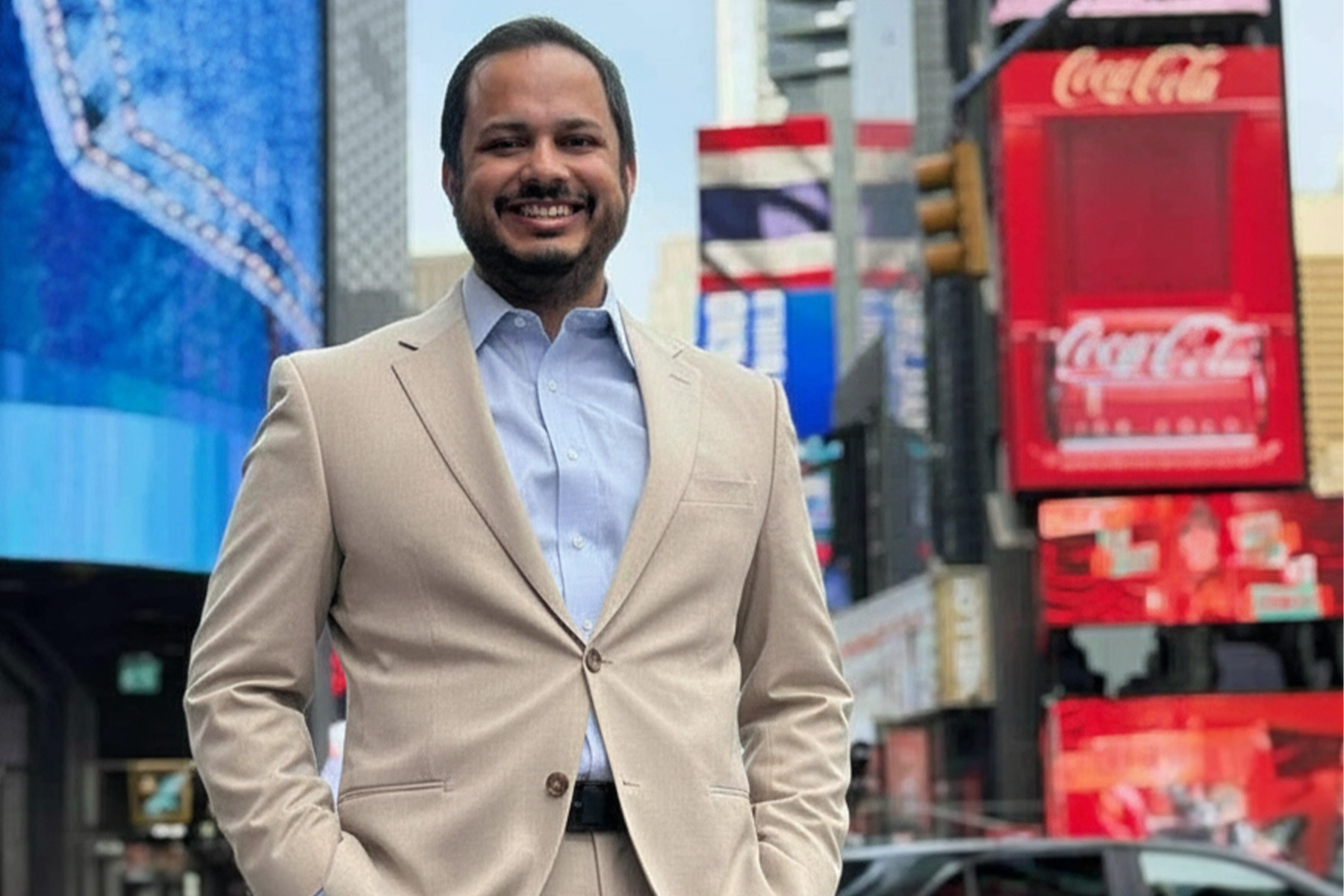
Minhaj Chowdhury, Co-Founder and CEO of Drinkwell.
Piyush, too, became a Fellow within the first few years of establishing his organization, the SaveLIFE Foundation, which seeks to improve road safety and emergency medical care access in India, where road accident fatalities outnumber all other countries. Under his leadership, SaveLIFE has helped pass landmark legal reform and yielded significant results, including reducing crash deaths on two major highways by more than 50 percent each.

Piyush Tewari (right) with pedestrians during a Tactical Urbanism trial. Photo Credit: SaveLIFE Foundation
Like Minhaj, Piyush noted being able to cope with the indeterminate and fickle nature of this work—remaining, above all, focused on the problem and prepared to pivot when circumstances demand—as integral for emergent social innovators, especially if they are to grow into steady stewards leading durable organizations. His Fellow class and the broader Echoing Green community “normalized uncertainty and reinforced values-led leadership,” he told us.
For nearly 40 years, Echoing Green has identified early-stage talent throughout the world, providing the community, counsel, and funding necessary to transform novel ideas into tangible, systems-level impact. Minhaj and Piyush’s success represents what’s possible when social innovators are supported from the outset.
In light of their honor from Schwab, we asked the two to reflect on the state of the greater social impact field as well as the influence of their Echoing Green experience, including how the Fellowship honed them as then-nascent social entrepreneurs and how the organization still informs their efforts today. Responses have been edited for clarity.
Echoing Green frequently asks social entrepreneurs and innovators to identify and describe their “moment of obligation.” Has the way you tell the story of your catalytic moment evolved or changed in the years you’ve been involved in this work?
Minhaj Chowdhury: Yes. In 2014, my story centered on households without safe drinking water and our technology as the hero. A decade later, the “main character” is the water utility struggling to deliver universal service inside a broken “build, neglect, rebuild” system. Our work now focuses on scaling partnerships that change how infrastructure is owned, financed, and maintained. That shift, from person-level tragedy to systems-level leverage, made the problem feel solvable at scale. That realization is when this stopped being a chapter between college and a career and started becoming an obligation.
Piyush Tewari: What began as a deeply personal response to loss evolved through Echoing Green into a larger institutional responsibility. Echoing Green was the foundational catalytic moment—it transformed moral clarity into a mandate for systems change. Since then, moments like global recognition through [The] Skoll [Foundation] and the World Economic Forum have reinforced that obligation, expanding it from action to stewardship. Today, I see my moment of obligation not as a single event, but as a continuum that is renewed each time greater trust is placed in our work and its ability to save lives at scale.
You were both selected as Echoing Green Fellows within the first four years of your organizations’ respective inceptions.
Minhaj, what emergent trait do you think Echoing Green recognized in you and others in your Fellow cohort? How do you think that quality has developed and brought you to this milestone of becoming a Schwab Award winner?
MC: I absolutely adore my 2014 cohort. I think Echoing Green saw in a lot of us a tolerance for discomfort and ambiguity. We weren't attached to a specific solution—we were attached to staying with the problem, even when progress was slow, politically messy, or financially uncertain. Over time, that’s turned into an ability to sit with hard trade-offs: between speed and sustainability, growth and control, idealism and survival. That comfort with tension is what allowed Drinkwell to keep operating when many stalled and to eventually build something durable enough to merit this recognition.
Piyush, how did the Fellowship experience hone you as an emergent leader and social innovator? How has the relationship you’ve maintained with Echoing Green since continued to inform your leadership?
PT: The Echoing Green Fellowship came at a formative stage and profoundly shaped my leadership. What mattered most was the community. My fellow Fellows and Echoing Green’s leadership normalized uncertainty and reinforced values-led leadership. Over the last 14 years, this enduring relationship has provided perspective, encouragement, and accountability. In a journey that could easily have been isolating, Echoing Green’s deep sense of community made leadership feel shared, not solitary, and helped me grow into a more thoughtful steward of both my organization and its mission.
The philanthropic and social impact landscape has become particularly tumultuous recently. What are you nevertheless optimistic about?
MC: Last year was extraordinarily tough. Yet I’m cautiously optimistic that recent cuts in bilateral aid are forcing a long-overdue reckoning. Fewer resources mean harder questions about who owns systems, who pays when donors leave, and what actually keeps services running. That pressure is accelerating localization—not as a slogan, but as a necessity. It favors operators who can work with governments and communities to build services that survive budget cycles, politics, and climate shocks. The moment is noisy and painful, but it’s pushing the field toward durability over optics.
PT: I’m optimistic because complexity is not deterring social entrepreneurs—it’s drawing more people into problem-solving. Today’s leaders are engaging more deeply with systems, questioning old assumptions, and designing solutions that reflect the true multidimensional nature of the challenges we face. This moment is pushing the sector beyond linear fixes toward more durable, systemic responses. In doing so, it’s setting important precedents for how complex problems can be addressed in an increasingly complex world, and that evolution gives me real hope.
Since we were introduced to them more than a decade ago, Minhaj and Piyush have exemplified the ingenuity and resilience of an Echoing Green Fellow. Navigating fluctuating economic and political landscapes and frequent uncertainty, they have not only worked to execute their idea but have further innovated and pushed boundaries. We are delighted that the Schwab Foundation has recognized their leadership and impact.
