An audience of Echoing Green alumni, supporters, and ecosystem partners recently gathered in Midtown Manhattan for Backing Bold Leaders in Climate and AI—a Fellow showcase hosted in partnership with MetLife Foundation and the General Atlantic Foundation during the United Nations General Assembly (UNGA) and Climate Week—to learn how some of our most impressive Fellows are utilizing technology and AI in their work.
Fellows Charlot Magayi ’20, Gayatri Datar ’14, Minhaj Chowdhury ’14, and Suzanne Singer ’21 were the event’s featured social entrepreneurs. These impressive leaders make clear why MetLife Foundation and Anthropic have supported Echoing Green in building Fellows’ AI capacity at this moment. Through these partnerships, Fellows will influence how this fast-evolving technology can be used for good, including how it can be harnessed to realize even greater possibilities for social impact.
With generous support from MetLife Foundation, Echoing Green is investing in the infrastructure, partnerships, and capacity-building that social entrepreneurs need to responsibly scale AI in their work. In addition to supporting Echoing Green’s renowned Fellowship program for early-stage entrepreneurs, funding from MetLife Foundation’s grant will be used to provide capital for entrepreneurs implementing AI during the pivotal growth stages of their organizations after completing the Fellowship.
At the showcase, Echoing Green also highlighted another major AI partner. Through a new partnership with Anthropic, Echoing Green is helping social entrepreneurs leverage AI to strengthen communities and solve problems around the world. Over the next two years, Echoing Green will distribute $500,000 in Claude credits and licenses to Fellows, as well as applied AI engineering support generously donated by Anthropic. By putting this transformative technology in the hands of social entrepreneurs working in their communities, we can demonstrate AI’s full potential as a tool for social innovation.
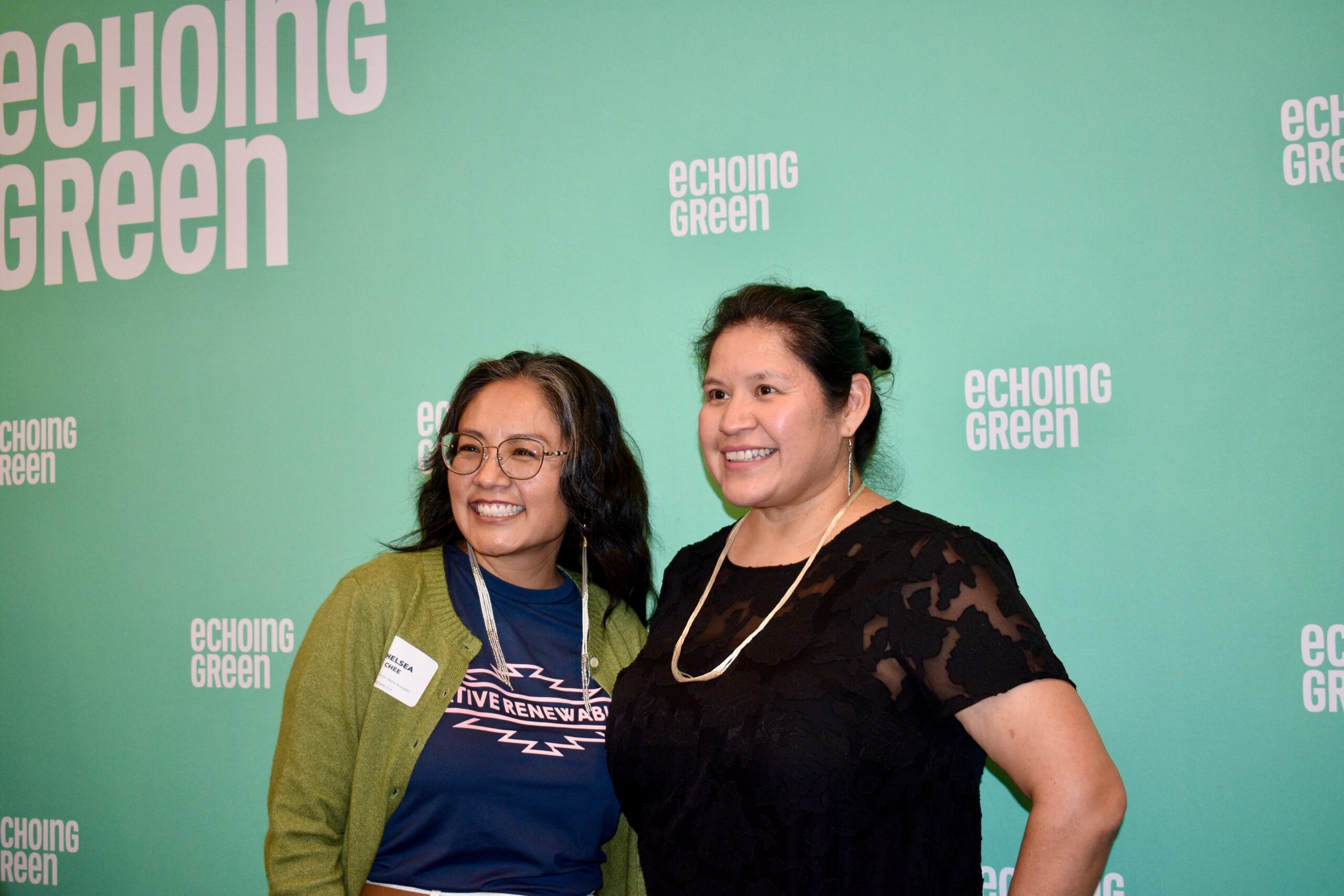
Chelsea Chee (left) and 2021 Fellow Suzanne Singer (right) from Native Renewables are pictured in front of the step and
repeat.
Backing Bold Leaders was, of course, not the only UNGA-week event where AI was the central topic. It, too, dominated conversation among world leaders at the UN Headquarters, just as it has across myriad industries and institutions, including at Echoing Green.
Echoing Green has not shied away from new technology. Innovation is core to who we are, and we’ve spent nearly 40 years discovering and amplifying emergent leaders with bold ideas for solving the world’s toughest problems. In the organization’s earliest years, emerging technology meant the internet and mobile phones; today, it is artificial intelligence.
Then as now, Echoing Green and our Fellows will be at the forefront of technology’s influence on social impact, leveraging AI and the new landscape it has created to maximize social entrepreneurship efforts and ultimately help build a better future.
“AI is redrawing the map of power and opportunity, and right now it’s concentrating both in fewer hands. But we have an opportunity to build something different,” said Alex Pan, Echoing Green’s senior director of capital. “If we want AI to disrupt systemic inequities instead of reinforce them, we have to put resources behind leaders who are closest to the problems, like Echoing Green Fellows, and help them put AI to work so that their communities benefit from this technology instead of being harmed by it.”
“I thought everybody’s grandma didn’t have electricity.”
During the showcase, Native Renewables founder Suzanne Singer dove into the intersection of climate and AI by recalling how visiting her grandparents’ home on the Navajo Nation distorted her understanding of most people’s access to energy. Growing up in Flagstaff, Arizona, Singer said that as a child she assumed that “everybody’s grandma didn’t have electricity,” either.
Years later, the 2021 Fellow explained to the showcase audience how Native Renewables—which trains local Indigenous technicians to install off-grid solar energy systems—is helping address inequities she once thought were normal. She also described the approach she’s taking with AI, one that is rooted in careful consideration of how the technology is impacting her community and their growing access to resources, including but not limited to electricity.
The event was a look into how some of Echoing Green’s most prominent Fellows are thinking about or already utilizing emergent technology, previewing the ways AI is already elevating their efforts and—thanks to support from MetLife and Anthropic—stands to make the work of social entrepreneurs even more impactful.
Gayatri Datar’s EarthEnable is on a mission to solve the housing crisis in Africa. It’s an ambitious aim given that the continent is projected to need 400 million homes by 2050, and the current housing stock is at just 15 percent of that, but AI has been a boon, Datar said. She described how the organization is using drones to conduct AI-powered quality assurance on construction projects in real-time, enabling developers to optimize the pace at which they build new units.
Mukuru Clean Stoves founder Charlot Magayi—who opened her presentation with the visceral moment that drove her to become a social entrepreneur, when her then-two-year-old daughter burned herself on a traditional Kenyan stove—said the technology could be a critical tool in reaching even more people. Mukuru not only designs stoves that are much safer to use, helping prevent accidents like her daughter’s, they also dramatically reduce household air pollution and employ hundreds of local businesswomen. AI paves the way for Mukuru to expand into the most hard-to-reach areas and serve even more people than the hundreds of thousands it already has across Kenya, Ghana, and Nigeria.
“As Mukuru grows, I see AI as a powerful tool for taking clean cooking solutions much further into the last mile,” she said. “We’re exploring how AI could help train artisans across Africa to manufacture efficient, standardized cookstoves, even in communities that companies and NGOs struggle to reach, while using better data to connect verified emissions reductions to carbon finance and create incentives for households to adopt cleaner technologies. Ultimately, the opportunity is to use AI to accelerate the transition away from open fires and inefficient traditional stoves, while ensuring local artisans are part of that transition.”
The final Fellow to present, Minhaj Chowdhury, who founded Drinkwell to address arsenic and fluoride water contamination in Bangladesh and India, was similarly encouraged by the promise of AI. Drinkwell uses a micro-finance model to locally-manufacture scalable, low-cost water purification technology, and AI is used to independently grade water quality, Chowdhury said.

Five attendees are pictured talking at a high top table.
The showcase event featured social entrepreneurs five years or more on from their Echoing Green Fellowships, helping demonstrate how implementing AI technology can enable organizations at the scale-up and beyond stages to accelerate and deepen their impact.
Fellows in Echoing Green’s most recent cohorts are also utilizing AI in more sophisticated ways than simply to improve efficiency. They’re using it to counteract systemic bias and close access gaps. One example is Antoinette Banks ’26—whose organization, Expert IEP, has supported thousands of students and families in accessing special education and disability services with its AI-powered equity infrastructure embedded into schools across the United States. Another example is Sabrina Ebengho ’25—who founded SAMI+, which deploys AI-powered portable ultrasounds to rural areas in the Democratic Republic of Congo, expanding prenatal care and helping reduce maternal and newborn mortality.
With support from our partners, Echoing Green is building on our strong track record of embracing new technology by equipping Fellows to make the most of AI’s transformative power and potential for greater possibilities in social impact.
