What do you think is a quintessential Echoing Green Fellow trait?
I think we all have the ability, or maybe, [the] imperative in us to look at things and be like, “Oh, it doesn’t have to be that way. It could be different.” “Oh, we don’t actually have to live like this. There is a different way we could all be doing things.” I think that’s pretty cool because so many people in the general public are like, “. . . guess that’s just the way it is,” and they don’t allow their imaginations to think about what could be.
What is your favorite time of day?
I love that moment in the afternoon when you’ve done all of your brain-heavy-lifting work. You don’t have any calls left, and the kids aren’t home from school or camp yet, and then you’ve just got those couple of hours to do whatever you want. That’s my favorite time of the day.
Last month, France became the first EU country to ban social media for children; meanwhile, Australia implemented its own ban last year and, in the UK, similar regulations are slated to go into effect next spring. Given that much of your research concerns the impact of AI on young people, especially the impact algorithms can have on children of color and other marginalized youth, what do you make of this trend?
I have a pretty nuanced, complicated response to this, but in simple terms, I don’t think the bans are the best idea. They’re not rooted in any science: We don’t have any research that proves that this type of intervention will improve the outcomes that we care about, which are youth mental health, any kind of [relation to] addiction or dopamine, children being exploited on the internet. These kinds of bans, in theory, you would think might do that, but we don’t actually have any data to back up that claim. And the data on the impacts of social media on youth mental health are not as clearcut as one might assume.
[Yet] also, in this type of psychological research, the gold standard is causal experiments, right? One group gets the treatment and one group doesn’t get the treatment, and the people in those groups don’t really necessarily know what group they’re in, because the placebo effect is very real. So, in a sense, these bans will be interesting from the scientific perspective because we will now have something that is similar to a natural experiment, where some countries will implement this and some won’t, and we can compare and see what happens.
But in the meantime, we have to contend with all of the drawbacks of the bans, right? How is anybody even going to enforce this? In that sense, it feels a little bit like political theater, “We’re doing something to save the children!” But what are you actually doing; how are you going to [do it]?
It would be much easier to regulate the handful of tech companies themselves and impose very heavy sanctions on tech companies for the harms that we assume they are producing and hold them to a higher standard than it would be to regulate millions of children, or millions of households. Also, this is kind of a cop out because what we’re doing now is shifting that burden to families. It provides the illusion that something is being done to solve this “social media problem” without actually holding accountable the people who are responsible for that problem, which are not the parents and not the educators and, certainly, not the children. It is the tech companies. I fear that people will see this as a political win, a regulatory win, and all of the momentum we’ve built to hold these tech companies accountable, the wind will basically be taken out of those sails because we can point to this regulation.
Which Fellow(s) from your cohort do you most admire?
Maria Uloko & Jahnavi Rao
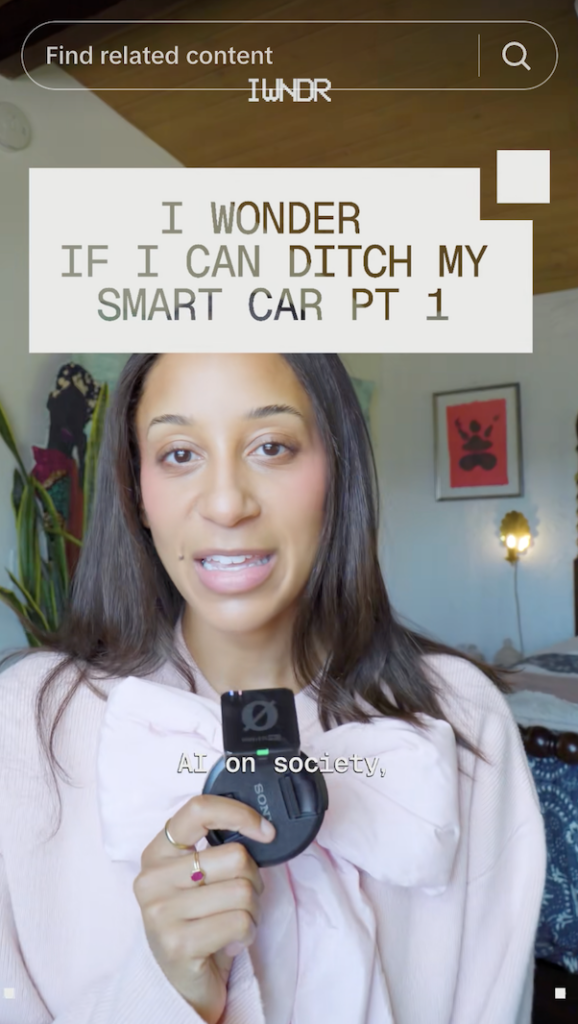
Avriel Epps’s short form videos have received more than 25 million views across her social media channels, including TikTok.
On your TikTok account, you’ve been documenting what you’re calling your “analog year,” which has included changes like switching over to a “dumb phone” and a “dumb car.” As you’ve worked to phase out certain products and habits, what has been the most unexpectedly challenging part?
I didn’t anticipate [that] it would be so psychologically and emotionally challenging. I knew it was going to be technically challenging, [and that] it was going to take some time, but I’ve come up against some significant psychological hurdles, where I’m like, “Oh, this.” I feel overwhelmed, or I feel like it’s really difficult, and sometimes in illogical ways. But I think this kind of underscores the point I was just making [about social media bans for children], which is that if we shift the burden onto individuals to solve problems like privacy, for example, or addiction-seeking behavior or whatever, it’s actually really hard for individual people to do that.
I think the other thing I realized is that when I use my dumb phone, there are a lot of things that are just not available to me. We live in such a smartphone-centric society, so, like, something as simple as a lot of restaurants just have QR code [menus] now. I went to Vermont on a trip, and I didn’t bring my phone the whole week. And in Montpelier, where we were staying, the parking meters didn’t have credit card readers on them—it was just coins or a QR code to pay. It’s just like, well, I don’t have any coins. Who has coins?
What was the last book you read?
On Intellectual Activism by Patricia Hill Collins & Saving Time: Discovering a Life Beyond the Clock by Jenny Odell
At Echoing Green, we have many Fellows engaged in AI-related work or whose efforts are powered by AI tools. Because it can have both positive and negative implications, depending on how it’s used, AI is a hotly debated topic. What is a contradiction about AI that you wrestle with yourself?
I think the reason that’s a hard question to answer is because it depends on what kind of AI we’re talking about. But I think the reality is that people really hate generative AI, right? And then people tend to be okay with the kind of AI that recommends Netflix movies to us, or which creates custom Spotify playlists. People tend to be okay with content recommendations, machine learning algorithms, which is interesting to me because [there’s] this hate for generative AI, but an acceptance that content recommendations are okay. The tension for me is that you could think of it as this is inherently two different products, and one feeds off of the theft of intellectual property, contributes to deep fakes, does all these bad things, but also there are a lot of huge issues with recommendation algorithms as well. They feed into political polarization; they disproportionately harm Black and brown folks or other marginalized folks.
Even in this analog year—my surveillance resistance analog year that I’m tracking and doing content around—I realize the irony of talking about these things on a platform that, in my opinion, contributes just as much to these harms that I’m discussing. That’s a tension I feel personally. The thing that I see out in the world that is hard for me to see and not constantly be annoyed by is people being afraid that this technology spells doom: doom for society and for humanity. . . It is the human people, the oligarchs who are the heads of these companies, and the people, most importantly, who are financing them, that are doing the harm. And the AI, the actual technology, is just their vehicle for sucking up all the resources and gaining more power and more control over our lives, and they mostly do that through regulatory capture, not by whatever products they’re selling us, but by infiltrating our political system. I really wish more people were more scared of those guys than they are of the [idea that the] models are gonna break everything or rise up against us, or whatever the weird fanfiction people have about AI [is].
What are you doing tomorrow?
I have meetings and I have therapy. One of the meetings is not that boring. My partner and I have a standing weekly meeting to not talk about work, but to just meet about the state of our relationship, how we’re feeling, how the kids are doing; any financial things we need to talk through. It’s like our stand up—our relationship stand up. It always happens on Fridays, and that’s one of my favorite meetings of the week.
