“The rejection of democracy is not a crazy thing for a young person who has only [ever] experienced democracy in shambles.”
With Election Day in the United States just days away, and early voting already underway in critical races nationwide, 2025 Fellow Jahnavi Rao and the high school student volunteers with New Voters—the organization she founded in 10 years ago as a high schooler herself—are in the final sprint to register eligible young people to vote and ensure their voices are heard in this year’s midterms.
Although a Tufts University poll found that nearly 60 percent of eligible voters aged 18-29 said they were likely to vote this year, historically, young people are the country’s lowest-propensity voters. But rather than chastise Gen Z for their apparent indifference, Jahnavi says we should examine the political environment they came of age in.
In the latest edition of our Leader Lens series, Jahnavi spoke about what she’s hearing firsthand from New Voters’ student volunteers working to mobilize their peers, as well as her perspective on the role social media algorithms play in creating civic apathy and what she sees as the trait all Echoing Green Fellows share.
Recent surveys have shown that young people in particular are dissatisfied with and have low trust in democracy, with a subset of Gen Z even displaying an openness toward authoritarianism. How do you engage with young people who reject democracy on principle? What do you make of this trend, where some young people are not just skeptical of voting, but of democracy itself as a political system?
The first thing is an acknowledgement that it is not a crazy idea to have, right? The rejection of democracy is not a crazy thing for a young person who has only [ever] experienced democracy in shambles. And I think that a lot of times people hear a young person saying, like, “Democracy doesn’t work,” or rejecting participating in the system as a sign of the end times and an indictment on that young person. But it often comes out of an abundance of wanting to see things change, and I think the biggest thing that comes out of it is a lack of agency, a lack of political efficacy.
When I’m engaging with those people, oftentimes it starts with, “What is something that you want to see happen in the world?” And there’s not a young person—there’s not a person on the planet—who doesn’t want something to happen. It can be as simple as “I want the Eagles to win the Super Bowl.” It can also be, “I want my church to have funding for new pews,” or “I want my school to give me access to the fields on weekends and put the lights on at night for evening practices.” These are all real things that I’ve heard from students.
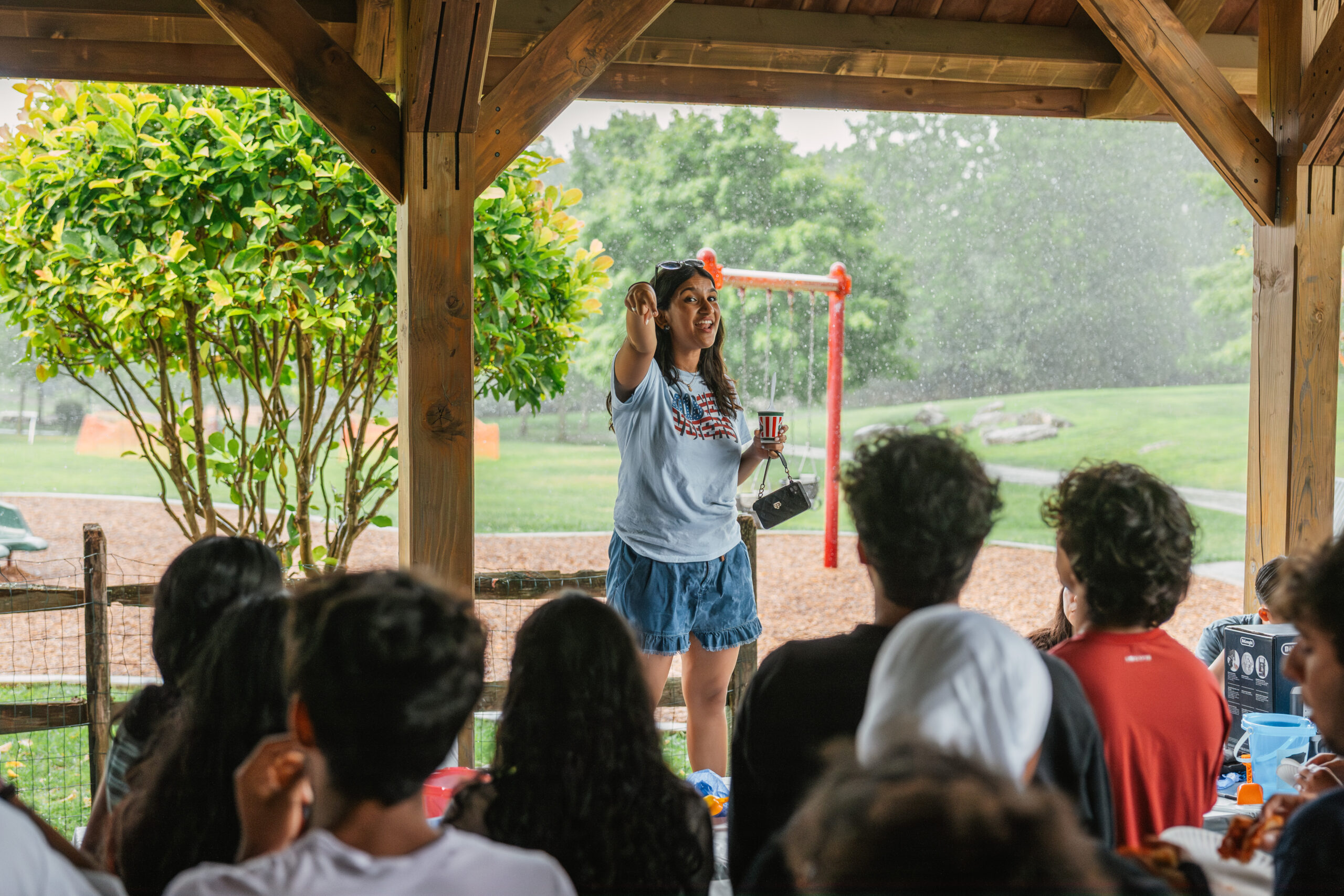
Jahnavi Rao speaks to students at Grad Fest.
I also ask about a time that you have cared about somebody else and done something about it—I think [about] framing voting as an opportunity to act on that care. Talking about the slim margins of local elections and how those local elections determine these areas that they care about, because they often do.
I tie it back to the idea [of]: What is the identity that you as a person hold for yourself? Do you think of yourself as somebody who cares? And I think most people think of themself as somebody who cares. [But] do you think of yourself as somebody who can make a difference? And I think most people don’t. That belief needs to be held in order to push someone into further civic action, with voting being the easiest step to take in that regard. You need to build that belief in the individual, like in yourself, and then you also need to build a belief in the collective, because I think it’s really important for young people to believe that they can do anything, and it can be upended very easily. The low voting rates are a symptom of a broader problem rather than in and of itself.
In our interview with Avriel Epps ’25, she spoke about what unchecked AI, algorithms, and social media can endanger. One example Avriel cited was recommendation algorithms, noting how they can encourage political polarization. Have you observed similar examples in your experience with younger voters? Relatedly, how do you think social media algorithms inform young people’s attitudes and (in)action regarding voting, and their politics in general?
I would say our students are probably the first to point out social media aspects. When asked about what’s wrong, what’s happening, why people, you know, engage, a lot of them will point to social media as the first thing. I think that there is a deep acknowledgement amongst young people of the echo chamber that social media creates, and the macro-level negative effects it has.
The challenge on social media is it is heavily unregulated, and it is heavily susceptible to both foreign and corporate influence when it comes to what information comes across your desk. And as much as a young person is aware that there are pseudoscience things floating [around], and that you know AI can alter the content [that comes] across your desk, [even] I personally find myself susceptible to things sometimes. Media literacy can only take you so far when you’re getting fully doctored images and videos, right? So many studies have shown that algorithms radicalize young people. I think that it probably doesn’t create apathy as much as it creates helplessness.
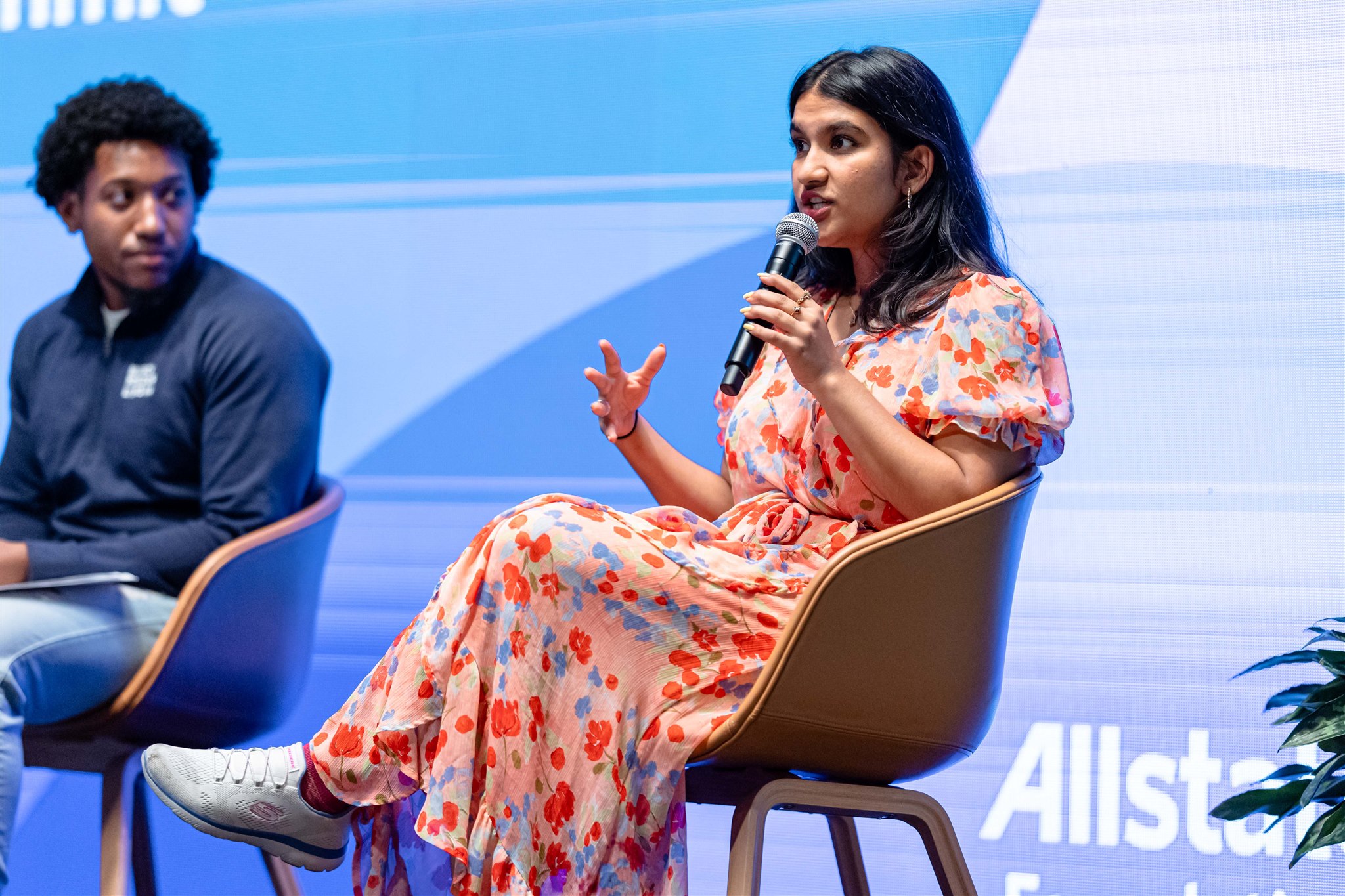
Jahnavi Rao participates on a panel at an Allstate Foundation event.
Around 20 countries, such as Australia, currently have compulsory voting. Would you support such a measure in the United States in response to low voter participation rates, essentially making voting a civic duty like serving on a jury?
The data suggests that compulsory voting, specifically in Australia, is highly effective, both at obviously increasing voting rates, but [also] at increasing people’s feeling of involvement in the government. I would say that I would support, first and foremost, a move like the measures in H.R. 11—I believe it’s called the Freedom to Vote Act—but there are also a bunch of [popular] very low-stakes common sense reforms, [while] compulsory voting is not wildly popular. What is wildly popular is getting rid of gerrymandering and fixing the electoral college. So, my priority would be the efforts that Americans currently are very passionate [about]. I mean, down the line, compulsory voting I think will obviously increase the voting rates, but I don’t think that it addresses the core thing that I believe is the foundational ill, which is the lack of agency. That has to be fixed by a responsive government, [which] happens when you eliminate forces that result in a non-responsive government, such as corporate money in politics. That compulsory voting does not solve the core issue. I don’t have a moral problem with the idea of compulsory voting, but I think why not do the things that Americans broadly support first?
What do you think is a quintessential Echoing Green Fellow trait?
These are all people who identified a challenge in their community and in their lives and have taken efforts and been successful in addressing it. And I think that something that has really evolved for me through Echoing Green is that the belief is not just in their own ability to make change, but their belief in their community to create that change, and their belief in other Echoing Green Fellows. The level of care and support and guidance other Echoing Green Fellows have given me, and the opportunity to contribute back to them, has been invaluable.
Which Fellow(s) from your cohort do you most admire?
Maria Uloko & Doreen Toutikian. I mean, I could list literally every single one of them, but both of them are incredibly accomplished people who had huge, massive, important careers, and then [they] decided to go all in on the social impact side of things and have made such incredible impact on the people they serve—but also on me. I actually stayed with both of them when I was in Europe. I stayed with Maria for a weekend in Paris and Doreen for a weekend in Athens.
What was the last book you read?
London Falling: A Mysterious Death in a Gilded City and a Family’s Search for Truth by Patrick Radden Keefe
What is your favorite time of day?
When I go to CorePower [Yoga]. I love the mornings when I don’t have any calls before 1 p.m.
What are you doing tomorrow?
I’m going to be at the Clinton Global Initiative annual meeting!
